
618-692-4900 Call 24/7 For Your Free Consultation
Champaign Homicide Defense Lawyer
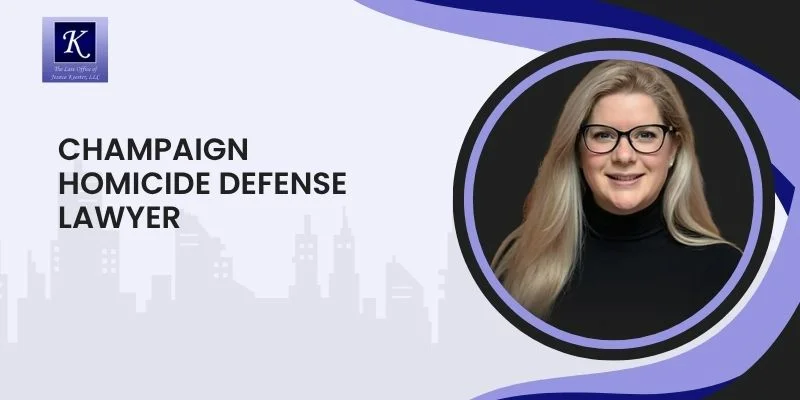
Trusted Homicide Defense Attorney in Champaign
A homicide accusation can turn your life upside down in a single day. Your freedom, your family, and your future may depend on what happens in the next few weeks.
Jessica Koester, a Champaign criminal defense lawyer licensed in Illinois since 2002, has spent more than twenty years handling serious criminal cases.She earned her law degree from the University of Notre Dame and built her practice so that clients get her direct attention, not a rotating team of associates. That kind of focus matters most when the charge is this serious.
Reach out today to schedule a free consultation. Let’s talk through what you are facing and what your options look like going forward.
Homicide and Violent Crime Charges We Defend Against in Champaign County
Homicide covers a range of charges under Illinois law, and the exact charge the state files shapes every decision that follows. We help clients across Champaign County fight:
- First degree murder, including charges built on intent and knowledge
- Second degree murder, where provocation or an honest but unreasonable belief in self-defense is at issue
- Voluntary and involuntary manslaughter
- Reckless homicide, often tied to a vehicle crash
- Drug-induced homicide, when prosecutors say someone gave or sold drugs trafficking that caused a fatal overdose
- Attempt murder, when prosecutors allege a killing was intended but did not happen
- Felony murder, where a death occurs during another serious felony like armed robbery or home invasion
Each of these charges has its own legal elements and its own available defenses, so the right strategy depends on which one the state actually filed against you.
What a Homicide Charge and Conviction Can Cost You
Few charges carry more weight than homicide. Illinois defines first degree murder under 720 ILCS 5/9-1. A conviction brings a prison term that starts at 20 years and can run to 60 years, or up to 100 years in extreme cases. When the circumstances are severe enough, natural life without the possibility of parole is possible. If a firearm was used during the crime, additional years can be added to the sentence. Illinois no longer has a death penalty.
Even before a conviction, your freedom may be at risk. Illinois abolished cash bail through the Pretrial Fairness Act, but murder is still one of the charges where the state can ask a judge to deny pretrial release entirely under 725 ILCS 5/110-6.1.
To keep you detained while your case moves forward, the state has to prove three things by clear and convincing evidence: (1) that the proof is evident or the presumption is great that you committed a detainable offense,(2) that you pose a real and present threat to a person or the community, and (3) that no set of release conditions could reduce that risk. These are separate showings, and a defense lawyer can contest each one with evidence about your ties to the area, your history, and the weaknesses in the state’s case.
How Our Champaign Homicide Defense Lawyer Builds a Defense
Jessica Koester built her practice around one idea: clients facing serious charges need direct access to the lawyer handling their case. She is a member of the National Association of Criminal Defense Lawyers, and she has been on the Illinois State Bar Association’s Committee on Corrections and Sentencing since 2012. This work helps keep her current on how Illinois courts actually apply sentencing law. In addition to Illinois state courts, she is admitted to practice in federal court, giving her a working knowledge of how a case can shift if federal charges ever enter the picture.
As a Champaign homicide defense lawyer, she reviews the police investigation line by line, looking for problems with the evidence, the forensics, or how the case was built, before deciding on the strategy that fits a specific charge.
Early work often matters as much as courtroom work. Surveillance video gets overwritten, phone and location data can age out of carrier records, and witness memories fade. Moving quickly to preserve evidence and interview witnesses shapes what the defense has to work with from the detention hearing through trial.
Possible Defenses to Homicide Charges
The right defense depends on the charge and the facts that can be proven. In Illinois, defenses generally either challenge whether the state can prove its case, or accept that an act occurred but argue it was justified or less serious than charged. Possible defenses may include:
Self-Defense and Defense of Others
A person may use deadly force when they reasonably believe it is necessary to prevent imminent death or great bodily harm to themselves or someone else. Once some evidence supports the defense, the state must disprove it beyond a reasonable doubt. Illinois also recognizes defense of a dwelling, which can apply when someone unlawfully enters a home and force is reasonably needed to prevent an assault or a felony inside.
Mitigating Factors
Second degree murder rests on a mitigating factor, such as serious provocation or an honest but unreasonable belief in self-defense. The defendant carries the burden of proving that factor by a preponderance of the evidence, meaning it is more likely true than not.
Misidentification and Alibi
Eyewitness errors, suggestive lineups, and unclear surveillance footage have contributed to wrongful homicide convictions. This defense tests how witnesses saw the event, how police conducted the identification, and whether phone, GPS, or video records place the client somewhere else.
Suppressing Statements and Evidence
If police obtained a statement in violation of Miranda v. Arizona, or searched a home, phone, or vehicle without a valid warrant, a motion to suppress can remove key evidence. Illinois also generally requires electronic recording of custodial interrogations in homicide cases, and an unrecorded statement can be challenged.
Forensic and Causation Challenges
Ballistics, DNA mixtures, and cause-of-death findings all involve interpretation. Independent experts can test whether the science supports the state’s theory, or whether another cause of death, such as a pre-existing condition or an intervening event, breaks the link between the defendant’s conduct and the death.
Mental State
An accident can negate the intent or recklessness the state must prove. Illinois also allows a not guilty by reason of insanity defense, but the defendant must prove it by clear and convincing evidence. Voluntary intoxication, by contrast, is not a defense.
Every defense is unique. No defense is guaranteed, and some cases involve more than one theory argued in the alternative.
Frequently Asked Questions
Do I need a lawyer right away if I’m charged with homicide in Champaign?
Yes. In a homicide case, the state can ask the judge to hold you without release. The judge must hold a hearing on that request right away. If a delay is granted, the hearing must happen within 48 hours of your first court date. Having a lawyer at that hearing can be the difference between going home under conditions and sitting in jail through your entire case.
Where will my case be heard if I’m charged in Champaign County?
Felony cases, including homicide, are heard at the Champaign County Courthouse at 101 East Main Street in Urbana, part of Illinois’s Sixth Judicial Circuit.
What happens at my first court date?
Your first appearance covers the formal charges against you and, in a homicide case, usually includes the hearing on whether you will be detained before trial. This is not the time to explain your side of the story to the judge.
Will my case automatically go to trial?
No. Some homicide cases resolve through a motion to dismiss or a negotiated plea to a lesser charge once the evidence is examined closely. The outcome depends on the specific facts and the strength of the state’s proof.
What does hiring a homicide defense lawyer cost?
Fees depend on the charge and how much work the case requires, so there is no single answer. The Law Office of Jessica Koester, LLC offers a free consultation so you can get a clear answer before deciding anything.
Can homicide charges be reduced or dismissed before trial?
Sometimes. criminal charges can be reduced when the evidence does not support every element of the original charge, and some cases are dismissed outright when the state’s proof has serious problems.
Does this firm handle homicide cases anywhere in Champaign County, not just the city of Champaign?
Yes. Homicide and violent crime charges from across Champaign County, including Urbana, Rantoul, and Mahomet, are all handled through the same Champaign County Courthouse and the same Sixth Judicial Circuit.
If you still have questions about your specific charge, reach out to talk through your situation directly.
Experienced Trial Attorney
Get Started On Your Criminal Defense
618-692-4900 Call 24/7 For Your Free Consultation
Contact a Champaign Homicide Defense Lawyer Before You Say Anything Else
A homicide charge moves fast, and your future is at stake. Jessica Koester has spent more than two decades defending people against serious charges across Illinois, and a free consultation can help you understand exactly where your case stands.
Contact The Law Office of Jessica Koester, LLC today, to schedule your free consultation.
Aggressive Criminal Defense In State And Federal Court
Get Started On Your Criminal Defense
Fields Marked With An “*” Are Required

100 North Main Street
2nd Floor, Suite 1
Edwardsville, IL 62025 Get Directions
© 2026 The Law Office of Jessica Koester, LLC • All Rights Reserved.
*Images are obtained under license from Canva and other third-party stock image providers, with attribution included where required.
Digital Marketing By: 